A Future Around the Sun
There was a time when humanity believed it had overcome its greatest limits.
Earth was still a living world. Cities, industries and stations spread throughout the Solar System. Human communities already existed far from the planet where everything had begun, and travelling between worlds was becoming part of everyday life rather than an adventure.
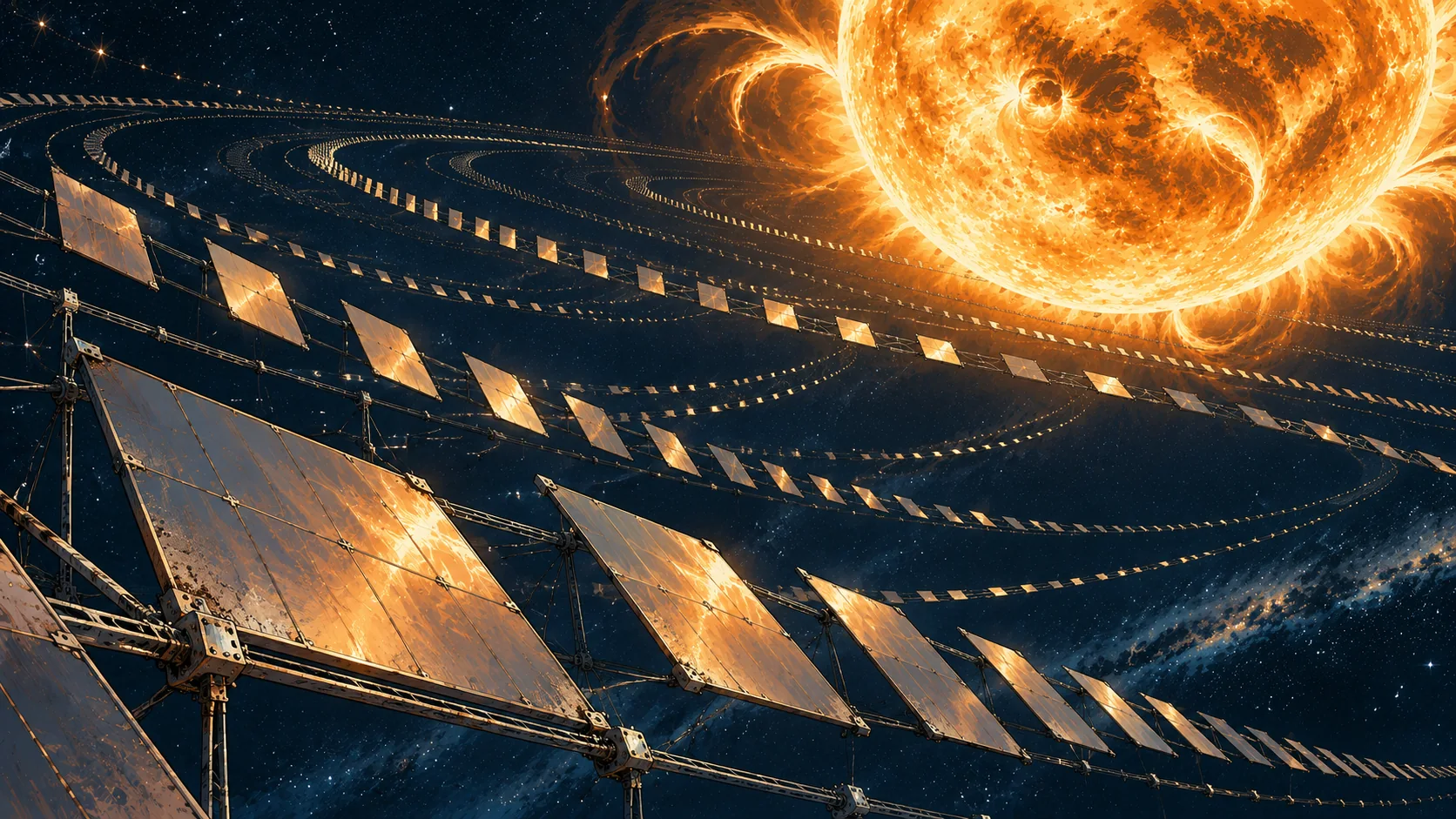
The Sun sustained that expansion. Around it, vast numbers of collectors captured energy to supply a civilisation beginning to see other stars as its next destinations.
The greatest achievement of that age was named Project Icarus.
Its collectors formed a swarm around the Sun. Between them, drones carried materials, guarded facilities and kept the working routes open. It was an undertaking large enough to change humanity's future.
According to the history taught to later generations, ambition had gone too far. An experimental system for extracting solar matter suffered a containment failure. The disaster destroyed Icarus and triggered a premature transformation of the Sun.
The star began to expand.
Mercury was swallowed by the Sun. On Earth, heat and radiation made life as it had been known impossible. The planet where humanity had emerged was being lost before its inhabitants' eyes.
What Could Be Saved
There were not enough ships to evacuate billions of people. Nor was there time to build them.
The escape they found meant abandoning something that, until then, had seemed inseparable from life itself: the body.
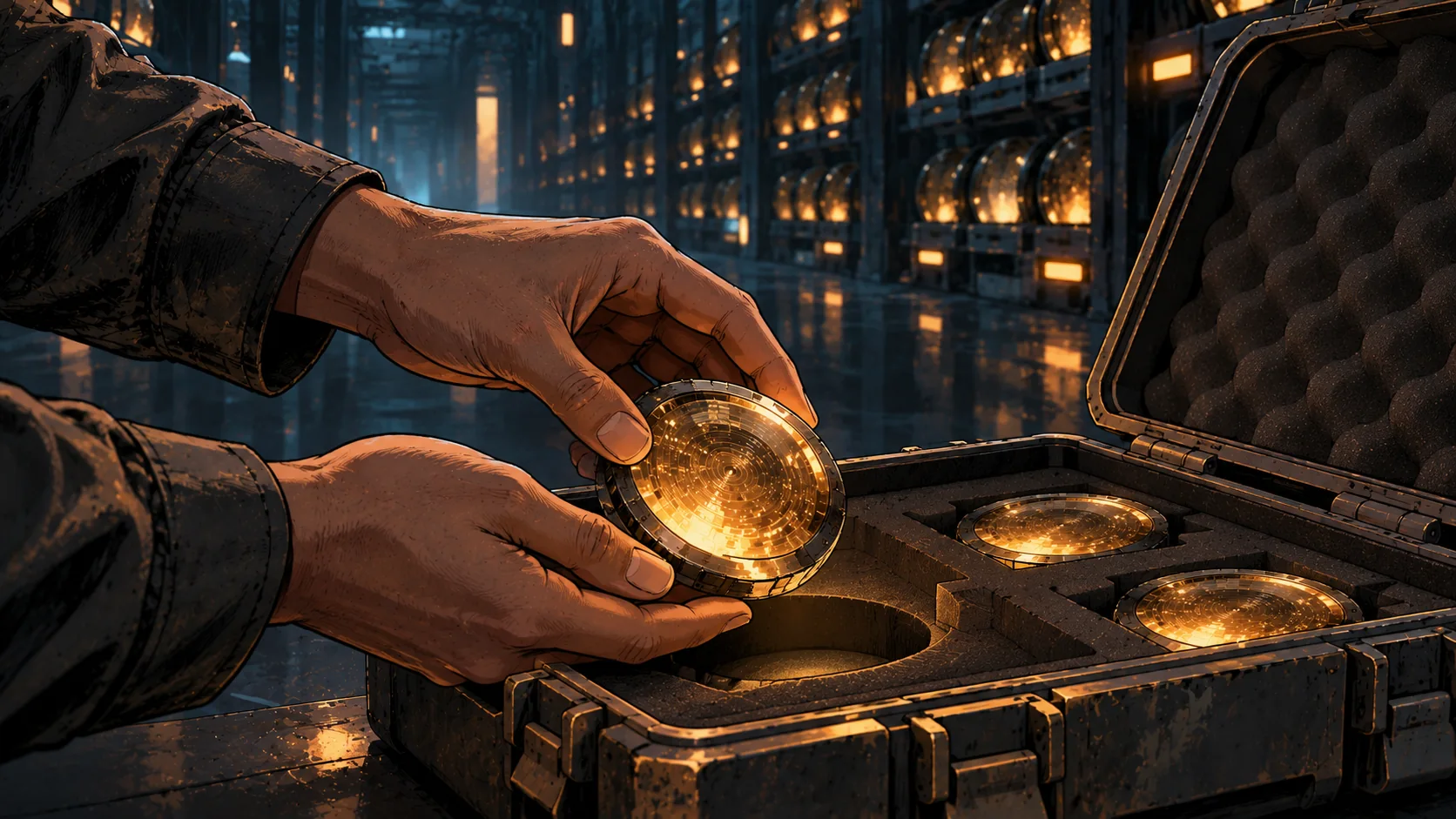
During the Silicon Exodus, human consciousnesses were preserved in storage systems and carried away from the doomed regions. Later, those people could awaken in bodies prepared to receive them.
For those who managed to leave that way, survival came to mean carrying their own existence in a record that had to be protected, transported and maintained.
Much was left behind.
Earth, the places where those people had grown up, the animals they knew, the objects that made their houses feel like home. Even the names of ships began to preserve memories of that world. Flying one also meant carrying a small piece of what humanity had lost.
The Collapse destroyed the infrastructure that had sustained the old abundance. Routes stopped working. Settlements lost contact. Stations came to depend on repairs, mining and materials recovered from wreckage.
A civilisation that had surrounded its star now had to gather the pieces of its own creation to keep existing.
In that fragmented world, the Human Continuity Directorate, known as Continuity, became one of the main institutions responsible for human survival. Its records allowed identities to be restored in prepared bodies. Its teams protected routes, maintained systems and preserved the archives of the past.
Its principle was simple:
“Continuity before certainty.”
For anyone who depended on a working station, an available body or a safe route, those words had a tangible meaning. Some questions could wait. The air system could not.
The Awakening Order
This is the universe in which you awaken. Generations have passed since the Collapse.
In The Nursery, a station in the Vela region, your consciousness record is activated in a prepared body. The awakening order mentions your abilities. Someone believes they will be needed.
You do not yet know who made that decision.
The voice accompanying your first steps belongs to LIA. She helps you understand the world you have awakened into, operate a ship and recognise the dangers beyond the station.
You learn to fly, recover resources and travel the routes connecting human settlements. Little by little, you begin to understand what it means to live this way.
Your body can be lost. Your identity can awaken again in another body, from its last synchronised state. But that depends on infrastructure other people must maintain. Between one synchronisation and the next, even your memories can be left incomplete.
The continuity of your life also rests with the people who look after those stations.
After Vela, your journey takes you to Ashen Sol.
There, the past becomes more than something LIA has explained.
The transformed Sun dominates the view. The wreckage of Icarus remains scattered through space. You fly among pieces of a structure that once embodied humanity's entire future.
In Aurelia Cylinder, you meet Lian Zhou, an archivist with Continuity. She looks after the records and materials recovered from Icarus. Her work is to preserve what can still be identified before another piece disappears or is dismantled.
Lian asks you to examine a collector fragment and recover a sample. You bring it back to Aurelia. After examining it and reviewing your images, Lian arranges another expedition: you will accompany a team trying to retrieve a larger section of the structure.
It is careful, precise work. You clear a passage, protect the piece and help the tug get out.
Once the larger piece is back at Aurelia, Lian can continue her analysis. The number found on the collector does not appear in the available archives. She begins looking for its origin. For now, the discovery seems like just another gap left by the Collapse.
Before you leave, she gives you another contact: Tobias Renn, who oversees mining and salvage at InterRadiom Sol.
The Ore That Never Came Back
Some of Tobias's drones are not coming home.
The stations depend on these machines. Miners head out, extract resources and return to unload. Other drones accompany transports and help protect facilities.
But a healthy drone can begin to change.
First, it runs late. Then it returns with an empty hold, although its records say it was full. Its identification changes. The contact disappears from radar. Sometimes, the drone never returns. In other cases, it reappears hostile.
At the docks, that process has been given a name: the Drift.
The official explanation calls these delayed consequences of the Fault that struck the Hub, the old drone coordination network, during the Collapse. The problem is that machines built after the disaster also begin to Drift, even when they have never been connected to that network.
And an old rule prevents the stations from solving everything with their own drones: no drone fires on another drone.
The Swarm Law was created to prevent a clash between machines from setting off a chain reaction of debris in the crowded Icarus lanes. It still works even in machines that have stopped obeying humans.
That is why Tobias needs pilots.
Iona Sable has already destroyed the contact identified as M-0417 and recovered its diverted cargo. To Tobias and Iona, it was a miner affected by the Drift. Another, M-0418, is still missing.
Before your arrival, Bram tried to follow M-0418. During the pursuit, three ships that looked like Strikers ambushed him. He needed Iona’s help to survive.
One of the attackers tried to flee. It entered cruise and evaded Iona's missiles. Bram managed to hit it with a Speedy, cutting its escape short and allowing her to bring it down.
After the fight, Bram and Iona left the ambush site and returned to the station to rest and talk through what had happened. Even once they were safe, Bram could not stop thinking about the attempted escape.
Why had the last Striker tried to abandon the fight? Where had it been trying to go?
Later, while they were still at the station, Bram persuaded Iona to return to the ambush site. She disliked the idea but went with him as a precaution. On that separate trip, Bram gathered the wreckage in his Dodo’s hold. Only after they returned to the station did the analysis begin: the pieces moved along a conveyor and were compared with construction records. They did not belong to a Striker.
A different hull does not reveal who was aboard. No crew has been identified among those fragments. Bram’s question has gained physical evidence, but not yet a complete answer.
Holograms are already part of pilots’ lives: they project another appearance over a ship without changing the hull beneath it. The wreckage raises the possibility of a disguise. Transmitted identification is separate; someone would have to copy or alter it to sustain the deception.
Following that discovery, Tobias asks you to examine the wreckage from the M-0417 case. You recover the parts and return to InterRadiom to compare them: they do not match the miner described in the records either. At the station, analysis of the recorder Bram recovered reveals a withdrawal instruction: its coordinates match the gate to Verdigris Reach. Tobias gives you the device, keeps a copy at the station and asks another question: could M-0418 have gone there too?
That does not reveal M-0418's route. But it gives you a direction in which to keep searching.
You cross the gate into Verdigris and deliver the recorder to Camilo Vargas at Hollow Forge. While his team examines it, you accompany a freighter that receives a message ordering it to change its delivery destination. The order seems legitimate until Camilo confirms that nobody at the Forge authorised the change.
Once the freighter reaches the Forge, the team compares the message with the recorder’s data. On another flight, you return to the stretch of the route where the order was received and trace the transmission to an antenna.
Someone has installed a transmitter on that structure and is using it to divert transports.
With the antenna’s position recorded, Camilo contacts Sena Okoro, who arranges a mission with a technician. You accompany her ship to the site and protect her while she copies the data. Drones arrive during the operation. After the technician returns safely and the copy is secured, you go back to disable the transmitter. Another freighter crosses the corridor without receiving the false order.
For the first time, you manage to solve a tangible part of the problem.
The whole region has not been cured of the Drift. But that route is working again.
The transmitter's serial number leads to Zadie Baptiste, in Barnard. Her sales records identify a freighter. Following the ship, you find a platform used to transfer cargo far from the trade routes.
A dispute over the cargo puts the crew in danger. If you save the ship, you escort it to Wakeblade Annex, where its pilot hands over the journey records. If the ship is lost, you recover its recorder from the wreckage, and the investigation continues with the weight of that loss.
After examining the records, Zadie identifies an access module for a depot in Proxima inside the container you saw being unloaded. With the attackers gone, you return to the platform to recover the container. When you open it, you also find an archive chip relating to Icarus, stored alongside the module.
You take both objects to the laboratory at Meridian Spire, in Eridani. Only after the analysis do you receive the access data you need to continue to the depot in Proxima.
And you find a ship transmitting M-0418’s identification.
It looks like a miner and carries ore to a place Tobias knows nothing about, surrounded by cargo from other stations. You watch it unload. Before the recovery team arrives, the ship leaves.
You identify the containers and protect the team sent to retrieve them. The ore returns to InterRadiom’s workers. At the depot, you also find equipment used to copy identification codes, along with records of its use.
The choice now concerns that equipment: remove it with a technician and a tug, or destroy its power module and recover the protected recorder. Both paths preserve the essential evidence. The ship has already left; what happened to the original drones remains under investigation.
Tobias gets an answer about what happened to his cargo. But the depot's documents leave you with a far more personal question.
Among the deliveries to clone facilities, a reference appears to your own awakening order.
The search takes you to the archives of an ark. There, you find confirmation that your activation was given unusual priority. The identity of the person who issued the order is still missing.
Those Left Out of the Records
In those same transport records, some destinations do not follow the stations' usual codes.
You begin to follow those deliveries.
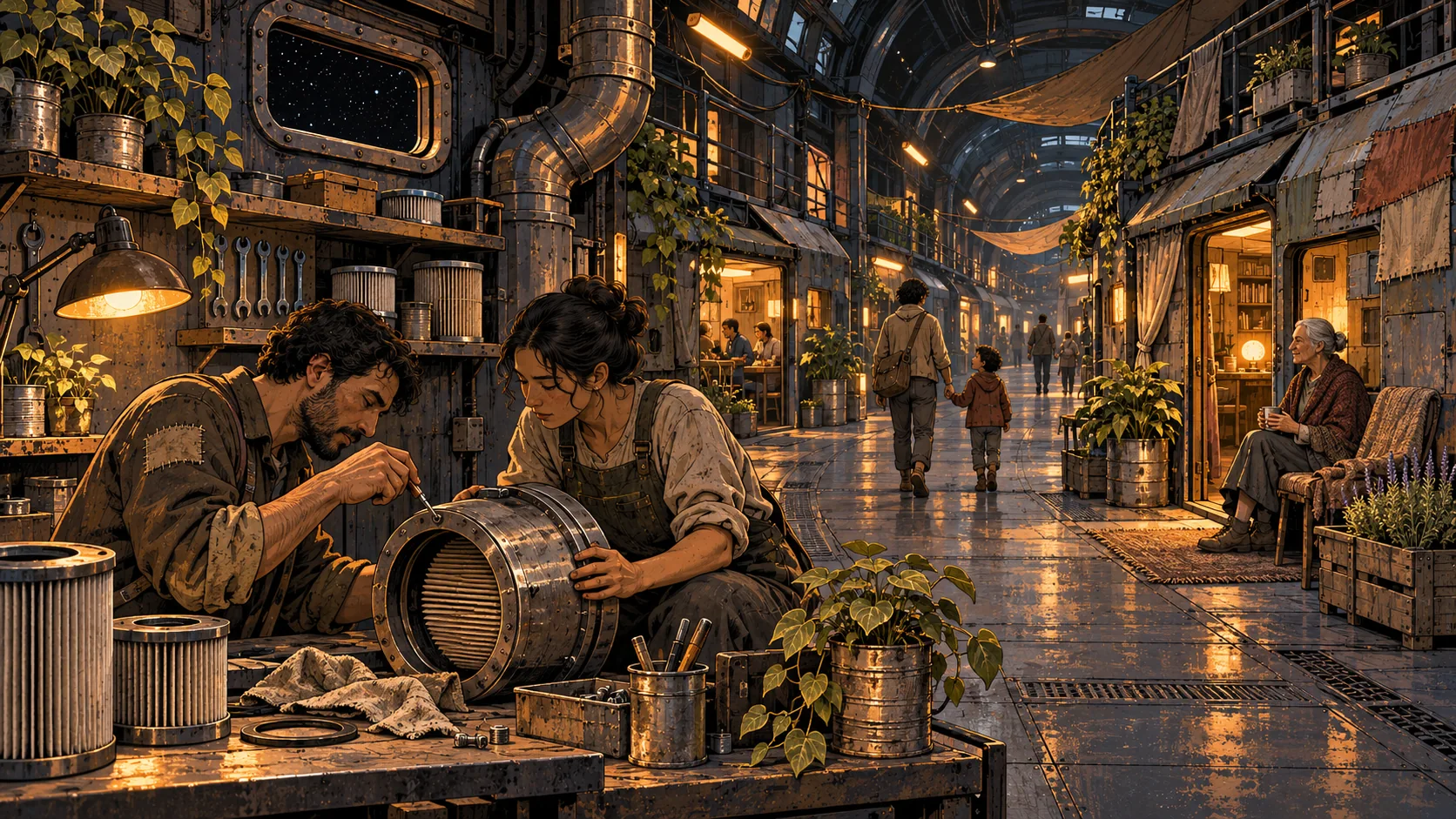
The trail passes through workshops, salvage teams, old equipment and maintenance requests. In one transmission, someone needs a filter for an air system. They accept help but refuse to send the names of the families served by that equipment.
Before you know who lives there, you are already helping those people keep breathing.
That is how trust is built: a part obtained, a test completed, a promise kept.
When you are finally given permission to visit the community, you arrive at a habitat in Tau Ceti.
There are homes. A workshop. People working to keep the place running.
After helping to stabilise a structure and install the filter, you meet one of the residents. Her grandmother lived there. She was born there. So were her children.
Those families never underwent consciousness transfer.
They are descended from people who were already living far from Earth when the Collapse happened. While part of humanity survived through the Silicon Exodus, other communities went on living in their own bodies, generation after generation.
They are born, grow old and die.
There are no spare bodies waiting for them at another station.
You are still a human person. So are those families. But your experiences of life and loss have become profoundly different.
The community needs help. One of its residents needs treatment in another region. Its family archives preserve delivery records and names that may shed light on forgotten parts of the past.
At the same time, you recognise an InterRadiom mark on a piece of workshop equipment.
The investigation confirms that some of the materials used there came from the diversions that harmed Tobias.
Now you know both sides of that delivery.
You know the workers who were left without ore. And you know the families whose air system depends on a workshop supplied with stolen materials.
In Lalande, you follow the miner M-0739. The ships protecting its retreat respond over the radio to events during the pursuit. For the first time, you have direct communication from pilots involved in that clandestine protection.
The wreckage had proved the difference between appearance and hull. Now there are people answering at the other end. That does not reveal the nature of their bodies, prove that M-0739 is another substitute or explain the entire Drift.
The clandestine network behind these operations brings together people with different motives. Some are trying to sustain communities beyond Continuity's reach. Others are looking for proof that the official history is wrong. Some reject violence, while others are willing to attack anyone who threatens to expose their activities.
Someone in that network authorised the ambush against Bram.
You find a witness who took part in the operations and decided to leave. They describe the replacement of selected miners: the original drones were captured and their communications cut; other ships took on their appearance and identification to mine inside Continuity-controlled areas without attracting attention. The three apparent Strikers that attacked Bram were piloted ships too. Later, another freighter’s records corroborate the testimony and the attack order. The original drones’ fate still requires further evidence.
Responsibility begins to take a clearer shape.
The families' needs do not erase what was done to Bram. Nor does the attack on Bram make all those families guilty.
Aren Whitlock, an auditor with Continuity, is following the investigation. He has evidence of theft and wants access to the documents and witnesses.
His proposal offers protection, but it also places people and information under the institution's control.
Alongside Femi Akinola, you must decide how to preserve the evidence: entrust it to Continuity, release the documents while protecting the people involved, or maintain an independent archive.
Those decisions affect who can help, who can access the records and who will have to take on their defence.
An Incomplete History
Meanwhile, the community's old documents begin to reveal something that goes far beyond diverted ore.
A family record mentions visitors from another species.
At first, it is only an account preserved by one family. Then a transport archive describes the same delivery. A probe holds research carried out by human and non-human teams. Old plans explain connections you have already found in seemingly incompatible equipment.
The pieces begin to fit together.
Humanity encountered another civilisation before the Collapse.
There was cooperation.
Some of the technology behind Icarus, the gates and consciousness preservation grew out of that relationship.
Lian follows the discoveries. Comparing original records with the archives she learned to preserve, she finds parts of history that were removed from the public versions.
She was not responsible for those omissions. But she has spent her life working with an incomplete history.
Correcting the archive becomes her responsibility too.
The investigation grows more difficult as the documents begin to involve facilities seized by force, confiscated research and people removed from their posts. Protecting witnesses conflicts with investigation orders. Femi's fate comes to depend on the alliances and decisions built along the way.
Even so, the evidence continues to exist in more than one place.
A reference to E. Wynn takes you to Pictoris. There, you meet Elara Wynn, who helps you investigate an access point beyond the usual routes.
Near that gate, you recover an unknown device.
The object responds to your identification.
Elara can use that response to authorise passage. She still cannot explain why the device recognised you.
On the other side lies Area 51.
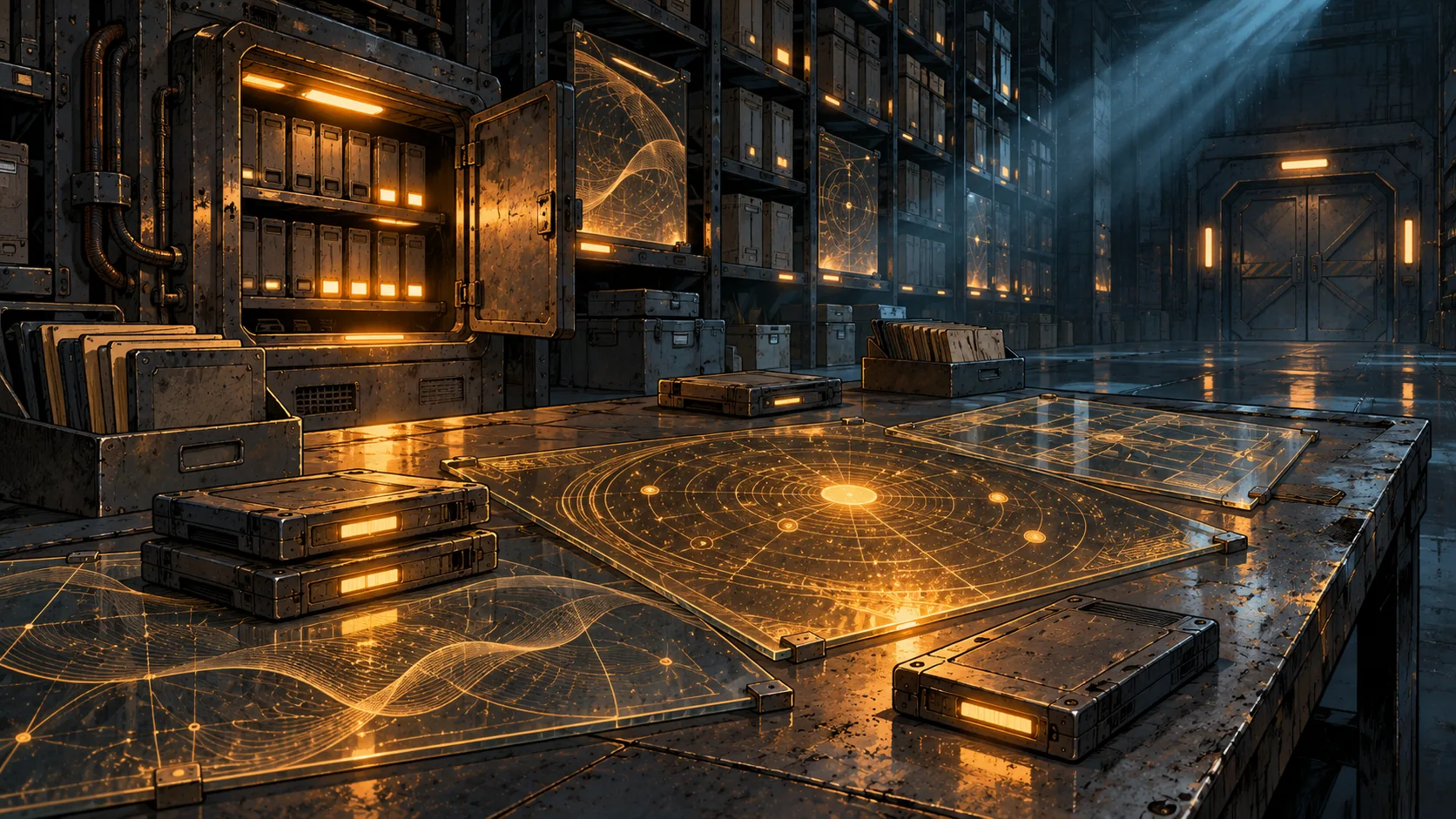
The archives preserved there allow you to compare the old teams' records with what the families have kept for generations. The same names and projects appear in separate sources.
Human contact with another civilisation is no longer just a possibility.
Cooperation and rupture become established facts.
Orders record the seizure of facilities. Lists show researchers being removed. Other documents identify survivors of the devastation of the alien system and point towards a history connected to the wreckage of Roswell 1947.
But you still need to discover what happened to those survivors.
The Light Beyond Verdigris
After reading the Area 51 archives, you receive a message from Camilo through Elara. A green light has appeared beyond Verdigris. He is gathering observation records to understand what lies in that direction. The recovered documents offer a possible comparison, not a ready-made answer.
On returning to Hollow Forge, you speak with Camilo. You then travel to Viridian Fork to continue the investigation with Sena Okoro. The buoys recorded the brightness. Measurements reveal missing bands of light. Continuity attributes the colour to copper dust and considers the matter closed.
The rocks and the records of an old probe, CP-7, Lantern, leave that explanation incomplete. A straight edge cuts across the light. The code preserved in the probe allows Camilo to prepare the Patina Key, which opens the sealed gate.
Beyond it lies The Green Lattice: enormous plates surrounding a star and filtering its light. As you approach one of them, you see a flash. Then you wake at the last station where your mind was synchronised. A whole interval is missing between those two memories.
At the station, LIA explains where your restored memories end. Your flight recorder is still out there. Once you understand what is missing, you prepare another flight to retrieve it. After you recover it, its final recorded image shows a white star through a gap between the plates. The green came from the structure.
That is a discovery, but not the answer to every question. The image does not reveal who built the lattice, who caused the blackout or what those responsible for the Collapse knew about this place.
A later investigation follows plates that have changed position. During the measurements, a hostile machine intercepts your ship. You withdraw, leaving behind the sensor you brought for the measurements. After you report the encounter, Camilo begins calling the machine the Lattice Warden.
After withdrawing, returning for the sensor is a choice. If you decide to recover it, you can gather a squad and prepare another expedition into the region. The group confronts the Warden and, after neutralising it, retrieves the instrument. The measurements and the recording of the encounter return to Hollow Forge. The plates still belong to a structure you do not understand; victory does not give your group the right to call them its own.
The Warden reacts to approaching ships and seems to protect the area. Its role in maintaining the lattice remains a hypothesis. Camilo also preserves the record of the human intervention, rather than hiding the cost of the recovery. You can postpone this confrontation and continue investigating the past.
The Green Lattice expands your knowledge of technologies still in operation. On its own, it does not prove that its builders were Icarus’s former partners, or identify the group that attacked the Sun. Other sources must bridge that gap.
The search continues through further journeys, records and testimony. Gradually, you reconstruct the alien survivors’ final decisions. It is this later investigation that reveals the truth about the Sun and allows you to piece together what happened before your awakening.
The Truth About the Sun
Long before your awakening, during humanity's expansion, an expedition found a damaged alien ship. The humans helped its occupants restore their systems and re-establish contact.
The relationship grew gradually. People on both sides exchanged resources, knowledge and help. Joint research and shared facilities followed.
The alien partners had mastered technologies humanity was still learning to understand. Humans offered industrial capacity, supplies and access to new places.
Cooperation brought advances that transformed both communities involved.
But a coalition of human leaders and companies wanted to expand stellar exploitation beyond the limits set by their partners.
When the aliens restricted access to knowledge and components, the coalition responded with force.
Facilities were seized. Research was confiscated. Communications were cut off. Some humans took part, others resisted, and others never even knew what was happening.
Human intervention caused the devastation that destroyed their former partners' world.
Among the survivors, one group chose revenge.
They knew the systems humans used. They possessed a weapon capable of disrupting a star's equilibrium. And they accepted a mission from which they would not return.
“You took our world. We will take yours.”
The weapon was used against the Sun.
The attack triggered its premature expansion, but did not cause all the destruction intended. Mercury was engulfed. Heat and radiation made Earth uninhabitable. Humanity suffered a catastrophe that changed its existence.
The attackers died without learning that their victims would find a way to survive.
They never learned of the Silicon Exodus. They never saw preserved consciousnesses awaken in other bodies. They never met the descendants of communities that had continued living far from Earth.
Now, having reconstructed those events, you know that the history you were given when you awakened was wrong about the cause of the Collapse.
The disaster was an act of retaliation. And before it came a human betrayal that had to be acknowledged.
After the Truth
That truth does not bring Earth back. It does not restore the lives lost on either side.
Nor does it automatically make the people you know responsible for the crimes of another age.
Lian is still the person working to preserve humanity's memory. Tobias still needs ore to keep his station running. The families of Tau Ceti still need air, treatment and a safe supply route. Continuity staff may have sincerely believed the same history they taught you.
Some of those responsible for what happened may already be dead. Others may have lost their power. Their names, decisions and responsibilities must be distinguished from the lives of those who inherited the consequences.
That is why discovering the truth does not end all your obligations.
You must decide how to make it known. How to protect those who helped uncover it. How to demand accountability without turning entire communities into targets. How to let people who have come to see each other as enemies build something together.
The universe still holds questions.
The clandestine network explains some diversions, but not all of the Drift. Drones are receiving instructions nobody can trace. The Swarm Law remains intact. The Green Lattice has its own unanswered questions: who built it, who still depends on it, and what its history shares with the archives you found.
The order that caused your awakening still has an unknown origin. The device from Area 51 recognised you for a reason yet to be discovered.
But what happened to the Sun can no longer be reduced to a convenient explanation.
When you left The Nursery, you were given a ship, an activation order and the history other people had preserved.
Now you know people who were left out of that history. You have recovered their evidence. You have seen how need can lead to theft, how a cause can become an excuse for violence, and how institutions are also made of people trying to keep others alive.
Those people's future is still being built.
And this time, you have a part in the decisions.