 Error Solis
A civilisation at stellar scale
Humanity turned the Solar System into its home, surrounded the Sun with machinery and began reaching toward other stars.
Error Solis begins after civilisation survives its greatest achievement—and its greatest mistake. Human minds endure, bodies are replaceable, and every journey outward is also a reckoning with what was lost.
The setting grows from one human decision: an advanced civilisation tried to force its next evolutionary step before it was ready.
Humanity turned the Solar System into its home, surrounded the Sun with machinery and began reaching toward other stars.
An experimental attempt to mine the Sun destabilised the star and transformed abundance into an extinction clock.
Unable to evacuate billions of living bodies, humanity preserved minds instead—and rebuilt human life around continuity without biological permanence.
Far in the future, Earth was no longer alone. Settlements on the Moon and Mars had existed for centuries, the Solar System had become humanity’s backyard, and a Type II civilisation drew energy on the scale of its star. Earth itself appeared to have escaped scarcity.
The next objective was Type III: expansion across the galaxy. That required energy for self-replicating probes, antimatter production and experiments capable of folding the distance between stars. Project Icarus was created to provide it.
A hyperdense Dyson swarm of independent collectors surrounded the Sun. Corporate and governmental impatience pushed an experimental star-lifting system into the network, extracting solar plasma to accelerate antimatter production. The civilisation that had learned to use a star decided it could also hurry one.
A failure in the magnetic-containment matrices triggered a catastrophic chain reaction. The swarm disrupted the Sun’s equilibrium, shattered into billions of incandescent fragments and accelerated the star into a premature red-giant phase. Mercury was consumed, Venus was lost, and Earth became lethal beneath heat and radiation.
There was neither time nor capacity to evacuate billions of biological lives. Humanity’s desperate answer was to preserve memory and consciousness in implanted devices small enough to carry between settlements. Prepared bodies could later receive those identities when labour—and survival—required them. Humanity escaped as information.
A clone in Error Solis is not a second person living in parallel. It is an inert prepared body. When a pilot dies, the continuing mental state awakens in one available body and consumes that resource. The person persists, but death still costs cargo, repair, place, time and another human vessel.
The original identity templates are guarded in The Nursery, a ship-like station sailing the protected region of Vela, and the place where every new pilot first wakes. It is both sanctuary and unsettling infrastructure: a cradle built because ordinary birth could no longer guarantee humanity’s future.
The player enters a society that inherited extraordinary machines but lost the networks, certainty and shared purpose that once made them ordinary.
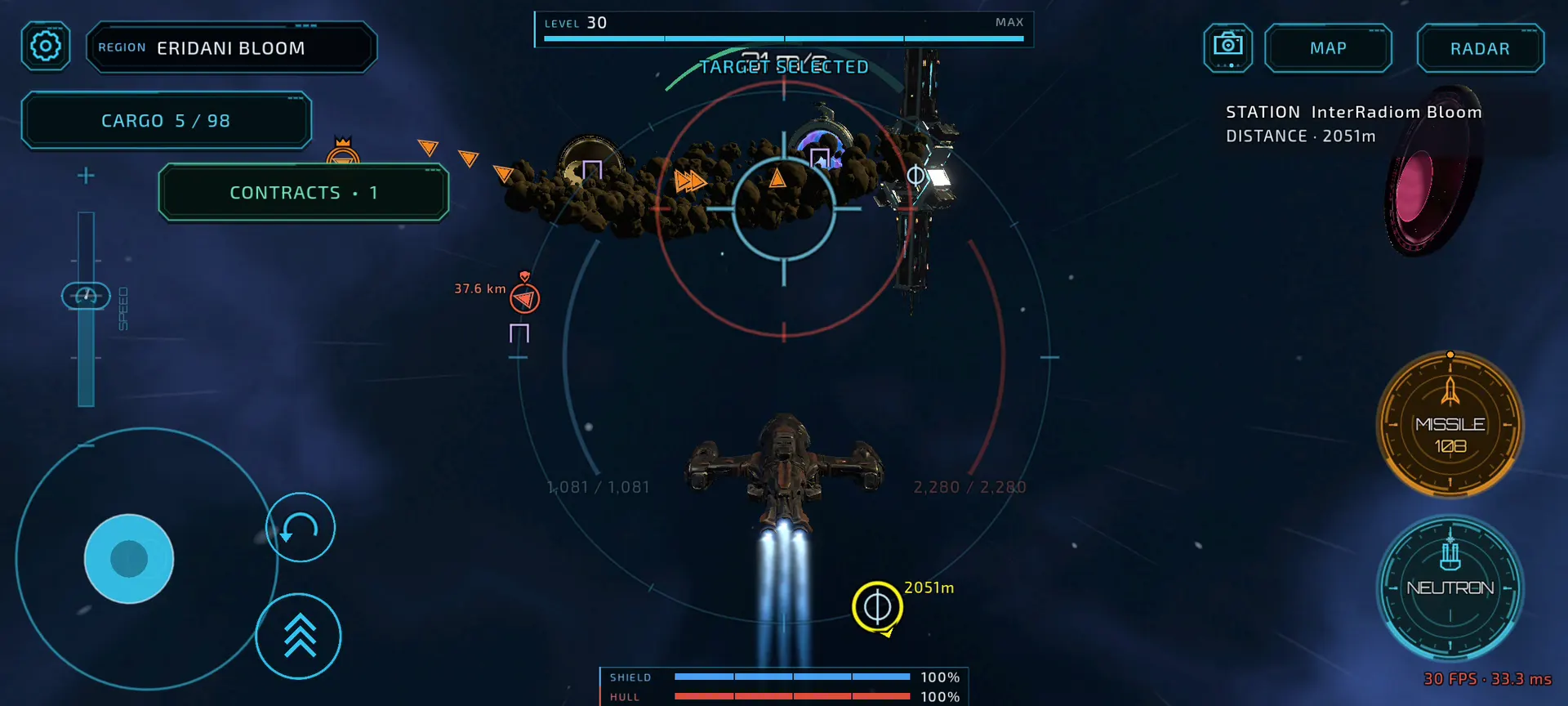
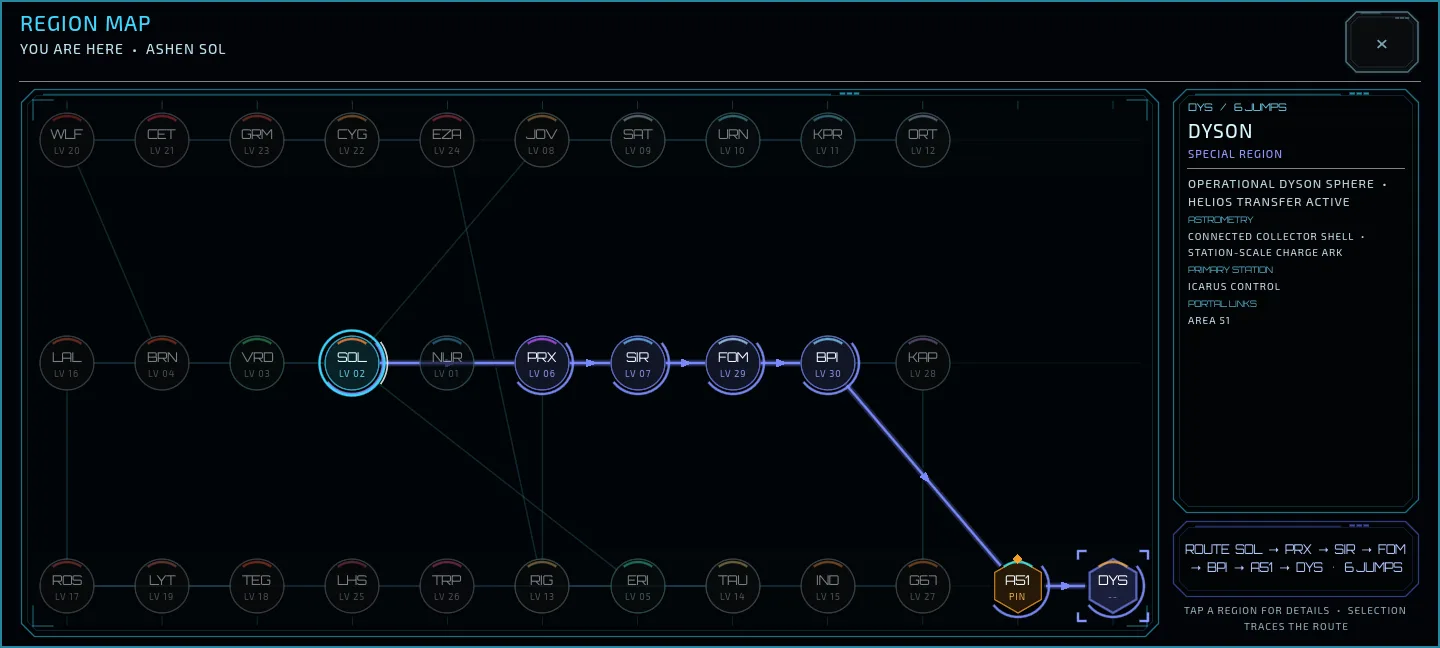
Visible gates connect named regions around the Solar System and nearby stars. Travel is physical, deliberate and never an invisible menu transition.
Asteroids, wreckage and Icarus debris matter again because the Collapse severed extraction networks and isolated entire settlements.
Miners, soldiers, traders, corporations, resistance groups and pirates disagree over who should control the remnants—and whether the old powers deserve to survive.
Humanity still chases reliable interstellar expansion before the damaged Sun consumes what remains of its original home. The ambition that caused the disaster never entirely disappeared.
Project Icarus and the Silicon Exodus are what every pilot is taught. The player’s story begins when the evidence stops fitting that account.
The player is not awakened by chance. Something in their archived abilities drew attention, and the activation order says those skills are needed for a contribution only they may be able to make. It does not say who truly selected them, or why the need has become urgent now.
At the end of a classified trail, Agent Elara Wynn helps the pilot recover an object that does not behave like cargo, a weapon or a conventional archive. It identifies the pilot and answers as a credential, opening access to the sealed human reserve known as Area 51. Why Elara chooses the pilot instead of reporting through official channels—and what she risks by doing so—remain unanswered.
Beyond the sealed route lies evidence recovered from a system once lit by two stars. Its older, more massive star collapsed into a black hole and began stripping its younger companion. The resulting accretion event and blast sterilised the region, but wreckage and machines endured. The scale of the remains suggests that humanity was not the first civilisation to turn a star into infrastructure.
A route absent from every public map leads from Area 51 to a human quarantine court and a ruined mothership kilometres long. The wreck proves that someone else existed. It does not prove that they all died, that they were biological, or that nothing of them survived inside the systems humanity later learned to build.
Signatures in the alien remains resemble foundations beneath human portals, consciousness transfer and perhaps Project Icarus itself. The discovery does not yet deliver a verdict. It creates a dangerous possibility: humanity’s greatest inventions—and the disaster attributed entirely to human ambition—may rest on technology whose origin and failure were concealed.
Error Solis is not meant to answer these mysteries in an exposition dump. Evidence, loyalties and consequences accumulate through play.
Earth’s animals survive as design memories. A bill can become a sensor spine, a shell can become a cargo fortress, and an animal’s movement or behaviour can shape a combat role. These are not mascots. They are functional memorials built by people who can no longer return to the world that inspired them.
A pilot begins as useful labour, learns to fly and chooses a permanent career. Later allegiance is meant to emerge from actions rather than a “good or evil” menu: protect settlements, serve corporate power, resist it, trade, mine, hunt pirates—or become one. The central question is not merely whether humanity can survive, but whether it can survive without reproducing the impatience that broke the Sun.
The universe is larger than the current release candidate. This page separates what can be played now from the long-term direction.
Error Solis on Android and the iPhone test build include full-3D flight, combat, mining, recovery, accounts, The Nursery, station markets, quests and 30 market-ready hulls. Area 51 and the off-chart Roswell wreck form a playable environmental mystery. The release-phone flight-feel baseline is approved. Limited shared-pilot presence is under test; a full online arena and persistent universe remain future work.
The branching investigation, the final truth and its faction consequences belong to later authored story phases, alongside online arenas, a persistent shared universe, player corporations, territorial conflict and the complete economy. They are narrative and design direction—not features presented as live today.
If someone has shared this page with you, any thought you choose to offer about its themes, human stakes, internal logic or unanswered questions would be genuinely useful whenever convenient. There is no expectation of a formal review, a quick reply or any commitment. One question or one honest doubt can be enough.