 Error Solis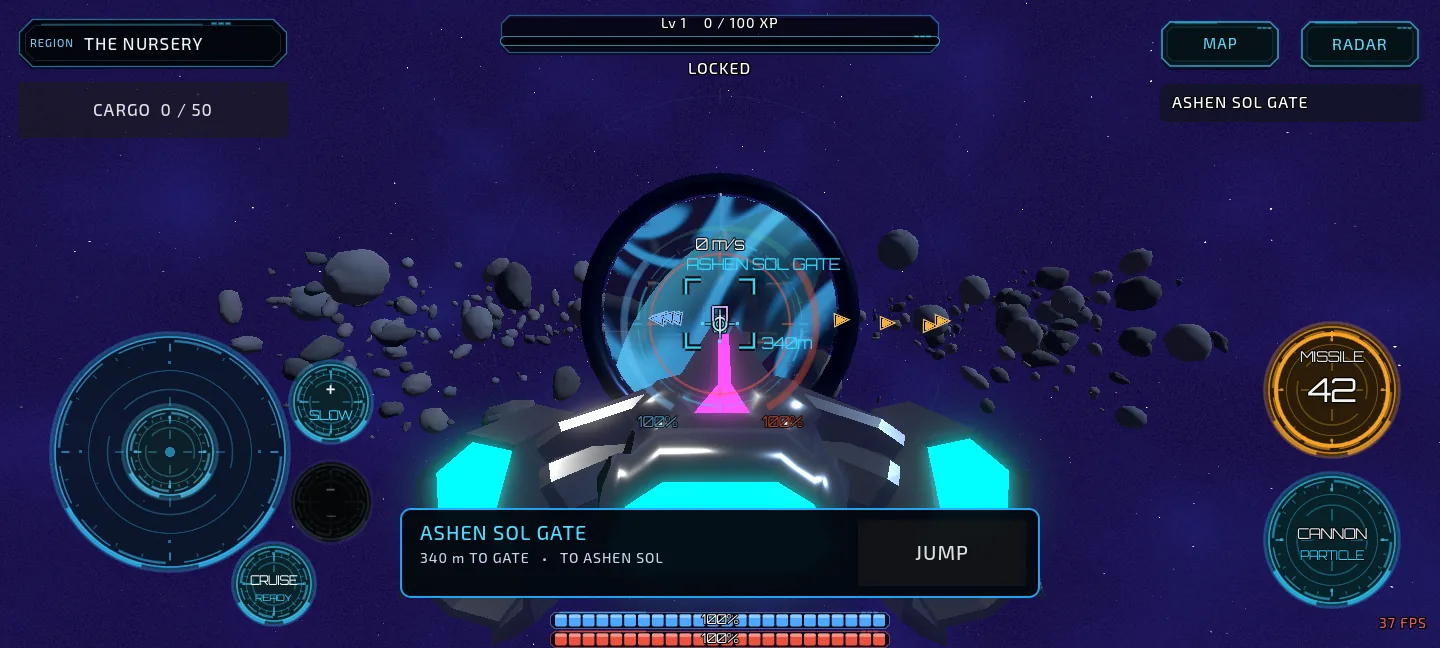
Fly where you point
The left control ring changes yaw and pitch. Pulling vertically does not move a flat marker up the screen; it pitches the ship's nose and changes the direction of travel. That means a pilot can climb, dive and loop without an artificial plane lock.
Free-look remains separate. Dragging empty space lets the camera inspect the fight, while steering recentres the chase view so the ship and aim remain connected.
A throttle you set, not hold
The throttle is a latched ladder: STOP, SLOW, HALF and FULL. The pilot steps it with large plus and minus controls, then returns the thumb to steering or weapons. This matters on a phone, where holding one movement button forever would consume attention and screen space.
Momentum has a cost
Hard turns scrub speed. Flying straight rebuilds it. The effect becomes dramatic in cruise, where changing direction is possible but no longer free. The result is arcade-readable rather than a physics simulator, yet the ship still carries weight through a manoeuvre.
Afterburner and cruise solve different problems
- Afterburner is a double-tap-and-hold burst on the steering ring. It doubles ordinary drive for up to ten seconds and recharges after release.
- Cruise is a separate fast-travel gear. It spools for roughly five seconds, reaches the hull's cruise profile and breaks when the pilot fires or suffers a hard interruption.
- STOP remains immediately reachable because a phone pilot must be able to end thrust without hunting through a menu.
Designed against a real phone
Error Solis does not size controls from its old 1152×648 project canvas. Runtime measurements on the physical Android build exposed a wider 1440-unit canvas, so the steering ring, throttle controls, cruise gear and weapon triggers are checked against real touch size rather than desktop assumptions.
The goal is not to reproduce a joystick on glass. It is to preserve the decisions of space flight while reducing the number of fingers that must remain held down.